
Magnetite, a prominent accessory mineral, plays a significant role in various geological settings, including volcanic, igneous, and metamorphic rocks. Its unique properties, such as high refraction and distinct crystal forms, make it a vital subject for thin section analysis. This comprehensive guide explores the characteristics, formation, and alteration of magnetite in thin sections, providing insights into its identification, microscopic features, and geological significance. Understanding these aspects is crucial for geologists, mineralogists, and researchers aiming to accurately analyze and interpret magnetite’s presence and transformations in different rock types.
Characteristics of Magnetite in Volcanic Rocks Thin Sections
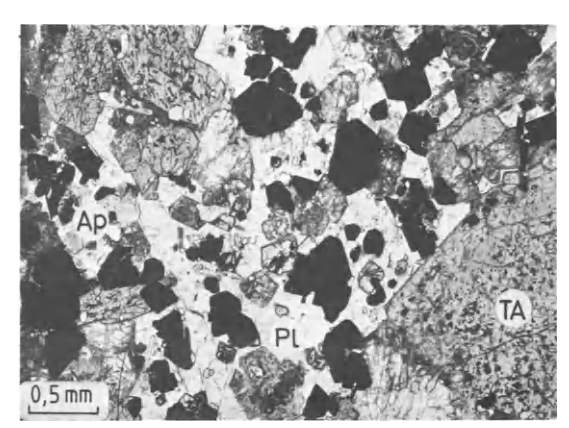
Magnetite is a common accessory mineral in volcanic rocks. In these rocks, it often occurs as titanomagnetite, where one part of iron (Fe) is replaced by titanium (Ti) (Fe₂TiO₄). The mineral can appear in various forms, such as square, rare triangular or hexagonal sections, and commonly as irregularly shaped aggregates or skeletal crystals. Its color is typically black, but in submicroscopic grains viewed in oblique reflected light, it can appear smoky-grey to dark brown.
Identifying Titanomagnetite in Thin Section Analysis
Titanomagnetite is identified in thin sections by its unique replacement of iron with titanium. This variation is common in volcanic rocks, where it forms part of the spinel group. The distinguishing features include its form, color, and extremely high refraction (n ≈ 2.4). Although magnetite is not transparent and cannot be used for refraction identification, its color and form help differentiate it from other minerals.
Microscopic Features of Magnetite in Igneous Rocks
In igneous rocks, magnetite typically appears as idiomorphic grains and as disseminated grains in the groundmass. Its form includes square, triangular, or hexagonal sections and irregularly shaped aggregates. Under microscopic examination, magnetite shows a very high refraction index and can be found in volcanic glasses, causing a brown coloration. Magnetite is more commonly found in basic igneous rocks (up to 5%) than in acidic rocks.
Magnetite Alteration to Hematite in Thin Sections
Magnetite is quite resistant to alteration, but it can oxidize to hematite, especially on the surface of lava flows. In volcanic environments, titanomagnetite can weather to leucoxene through hydrothermal and hydrous alteration, leading to iron loss. This alteration process is significant in understanding the stability and chemical changes in magnetite under different environmental conditions.
Formation of Magnetite Crystals in Thin Sections
Magnetite crystals in thin sections form in various shapes, including square, triangular, hexagonal, and irregular aggregates. They can also develop as skeletal crystals. These crystals are formed during the late stages of magma crystallization, often as deuteric minerals resulting from the breakdown of water-bearing minerals like biotite and hornblende.
Distinguishing Magnetite from Ilmenite in Thin Sections
Magnetite can be distinguished from ilmenite in thin sections primarily by observing the grain boundaries and forms. Graphite, which has less defined smeared grain boundaries and forms flaky parallel grains, can be mistaken for magnetite. However, magnetite can be distinguished from ilmenite if the latter shows skeletal forms or is altered to leucoxene. This differentiation is crucial for accurate mineral identification and analysis.
Occurrence of Magnetite in Clastic Sediments Thin Sections
Magnetite occurs in almost all clastic sediments and can be locally enriched in alluvial deposits. This widespread presence makes it an essential mineral for geological studies in sedimentary environments. Its identification in thin sections helps in understanding sediment transport and deposition processes.
Oxidation of Magnetite on Lava Flow Surfaces
On the surface of lava flows, magnetite can oxidize to hematite. This process is part of the natural weathering and alteration of magnetite under atmospheric conditions. Observing this oxidation in thin sections provides insights into the post-eruption changes and stability of volcanic rocks.
Magnetite Presence in Low- to High-Grade Metamorphic Rocks
In metamorphic rocks, magnetite is common in low- to high-grade conditions, typically appearing as idiomorphic grains. Examples include its presence in chlorite schist and as small grains in hornfels. This presence across a range of metamorphic grades makes magnetite a valuable indicator of metamorphic conditions and processes.
Refraction Properties of Magnetite in Thin Sections
Although Magnetite is not transparent and cannot be used for refraction-based identification, it exhibits extremely high refraction (n ≈ 2.4) . It’s refraction properties are observed in its color variations under different lighting conditions, such as smoky-grey to dark brown in oblique reflected light.
Conclusion
The occurrence and distinctive properties of magnetite make it an essential mineral for geological studies. From its formation in volcanic and igneous rocks to its alteration and presence in clastic sediments and metamorphic environments, magnetite offers valuable insights into geological processes and conditions. By understanding its characteristics, formation, and alteration in thin sections, geologists can enhance their analysis and interpretation of rock samples, contributing to a deeper understanding of Earth’s dynamic systems. This guide serves as a comprehensive resource for those seeking to master the identification and analysis of magnetite in thin sections.
I am genuinely thankful to the owner of this website for sharing his brilliant ideas. I can see how much you’ve helped everybody who comes across your page.
Your writing style is cool and I have learned several just right stuff here. I can see how much effort you’ve poured in to come up with such informative posts.